Summary of Oral Argument in San Francisco: California v. USA; Court of Appeals for the Ninth Circuit
/in General News, Governmental Affairs and Communications
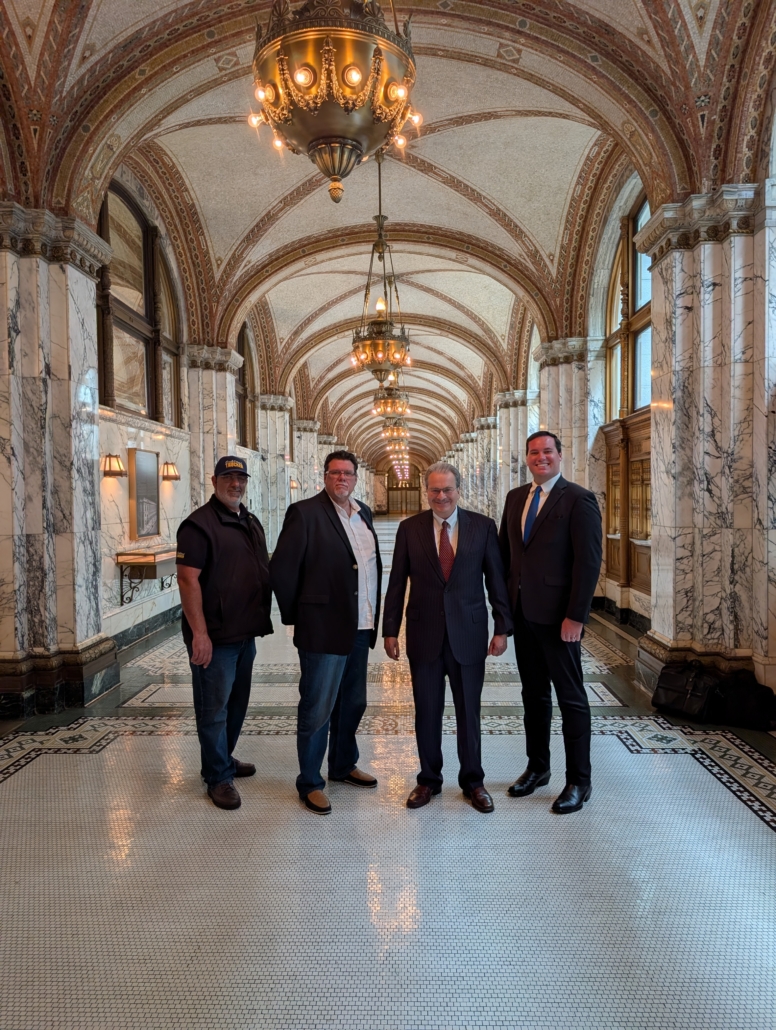
The Texas Public Policy Foundation (TPPF) recently argued before federal judges in a case that WSTA is following and that will affect our members. WSTA Executive Director, Lee Brown, WSTA Member Bill Aboudi, and WSTA Legal Council Pat Whalen attended the hearing. Here is a summary of the arguments, provided by Ted Hadzi-Antich, Senior Attorney for the TPPF:
Hi Lee,
As you requested, this email summarizes oral argument last week.
The three judges on our panel were all liberals appointed by Obama or Biden, and they were predisposed against us.
Counsel for the auto manufacturers, auto dealers, and fuel suppliers received a total of 15 minutes, while we received five minutes to argue on behalf of truckers. We agreed with co-counsel that they would present a macro picture of why the applicants for intervention should be permitted to intervene, while we would provide the details of the impacts on the trucking industry.
When our turn came, we began by pointing out that the facts set forth in the Aboudi declaration, the provisions of the federal intervention rules, the applicable case law, and common sense dictated that we should be permitted to intervene because we have a protectable interest in ensuring that the Congressional Resolutions remain intact, that no other party could effectively represent us, and that we had the right to intervene.
About two minutes into our presentation, one of the judges asked whether there was specific case law supporting our position that the Federal Government could not represent us effectively in this case. We explained that our briefs on that issue covered the question, but a second judge insisted that we point out a specific case that was not in the briefing. We told the court that we were not aware of any such case, but that common sense dictated that because the Federal Defendants are averse to us in the D.C. Circuit, they cannot effectively represent us in connection with the same subject matter in the Ninth Circuit. Seeing that time was running out, we reserved the remainder of time for rebuttal.
During rebuttal, we told the panel that regardless of their views regarding the inherent conflict-of-interest faced by the Federal Defendants, the applicable rules of intervention were squarely in our favor and that the entire edifice of the ACT Rule was based on targeting emissions from trucks. Accordingly, we told the court that, because truck emissions per se were the target of the ACT Rule, truckers were actually more entitled to intervene in the case than any of the other intervention applicants. That’s where we landed, and I think it made an impression on the court.
As you know, it’s difficult to predict the outcome of any case, and this one is no exception. We’ll have to wait and see what happens.
Cheers,
Ted
Ted Hadzi-Antich
Senior Attorney
(Admitted in CA, NY, MD, TN, D.C.)
Center for the American Future
Texas Public Policy Foundation
901 Congress Avenue
Austin, Texas 78701
Assembly Bill to Override CARB ACF Requirements on Private Contractors and Truckers Fails Before July Recess
/in CARB Consultant, General News, Regulations & CARBSean Edgar, Environmental Policy and Media Advisor
On July 1, as the California Legislature prepared for recess, a last-ditch effort to exempt privately-owned contractor fleets from the Advanced Clean Fleets (ACF) regulation failed. Assembly Bill 1436 (Avila Farias) failed to pass from the Senate Environmental Quality Committee on a 3-3 vote[1]. By virtue of this result, it appears unlikely that the California Legislature will intervene to put any guardrails around CARB’s plan to finalize the State and Local Government (SLG) amendments that first identified the contracting requirement language on April 2, 2026 and strengthened on July 1, 2026. The final Regulation is expected to become an official state regulation effective on or about September 1, 2026. Any privately owned fleet that contracts with public agencies should be prepared for a bumpy ride over the next nine months until the SLG reporting deadline and should brace for discussions with the contracting authorities on ZEV purchase that contractors will be required to make.
What we know about the ACF SLG implementation at this time is:
- All non-federal public agencies/municipalities/special districts must report ALL contractor vehicles >8,500 lbs GVWR of all fuel types into the agency’s CARB TRUCRS account by April 1, 2027. This includes all state agencies (like Caltrans), all 58 counties, 500+ cities and over 4,000 special districts such as water, power and sanitation districts), collectively “agencies.”;
- The agencies are responsible for their contractors to be in compliance with at least one of two compliance pathways;
- The “case-by-case” and “good faith effort” terminology used by CARB in their Guidance Document[2] is extremely concerning given that CARB has spent the past four years developing the Regulation.
- I serve on CARB’s ACF Outreach Committee so expect to be briefed as soon as CARB has additional information. My team has over 15 years of experience reporting into CARB TRUCRS and will be supporting the public agencies and affected contractors that we contract with.
WSTA continues to challenge the ACF SLG Regulation and that effort and an appeal for support can be found on the WSTA website.[3] Should you have any questions on that or the other aspects of this article, please contact Sean@Cleanfleets.net or (916) 718-7050.
[1] https://leginfo.legislature.ca.gov/faces/billStatusClient.xhtml?bill_id=202520260AB1436
[2] https://ww2.arb.ca.gov/resources/fact-sheets/ACF-2025-Amendments-Guidance
Caltrans Trucking Incident Summary Report (2024-2025)
/in Governmental Affairs and CommunicationsClick the folder icon at the bottom to download the report PDF.
CHP Begins Enforcing English Language Requirements During Inspections
/in General News, Governmental Affairs and CommunicationsDespite all the heated rhetoric and lawsuit filed by California over U.S. DOT cutting $40 million in Motor Carrier Safety Assistance Program (MCSAP) funding from the state for not enforcing minimal English standards for commercial drivers at roadside, the California Highway Patrol (CHP) has begun to actually enforce the decades old regulation (§ 391.11 (b)(2) General qualifications of drivers).
391.11 (b)(2) simply states, “Can read and speak the English language sufficiently to converse with the general public, to understand highway traffic signs and signals in the English language, to respond to official inquiries, and to make entries on reports and records.”
WSTA has confirmed with the CHP that “effective December 23, 2025, the CHP amended its Commercial Vehicle Safety Alliance North American Standard Out-of-Service Criteria regulations to incorporate the revisions adopted by the CVSA on June 25, 2025 (that responded to the April 2025 Trump Executive Order directing the FMCSA to strengthen the English Language Proficiency requirements for commercial motor vehicle operators). This change is incorporated into Title 13, CCR, Division 2, Chapter 6.5, Amended Article 7.5, Section 1239 (read it here).
Background
CHP had never really enforced the English requirement at roadside. It was only sporadically noted on inspections reports and only cited the federal code, not a state code for the violation. There was no action taken against the driver if found in violation. U.S. DOT actually noted that in 30,000+ commercial inspections, only one violation was noted. Meanwhile states aggressively enforcing the rule have hundreds or thousands of violations and following the requirements take the driver out-of-service.
This all came to a head in August of 2025 after a California licensed truck driver, Harjinder Singh made an illegal U-turn on the Florida Turnpike resulting in three deaths. Officials in Florida claimed Singh didn’t understand English and should not have been licensed. U.S. DOT then sent California a notice that it had not adopted compatible laws with federal regulations as is required to receive MCSAP funding.
The Newsom Administration instead of attempting to calm the waters decided to go down a path of obstructionism – even though the state was in the wrong…likely for political reasons.
In October, after attempting to get California to adopt and enforce the regulation – like most states, and California’s (read Newsom Administration) continued foot dragging and obstructionism, the feds issued a Notice of Final Determination of Nonconformity as part of a process to revoke $40 million in safety grants. At the same time, the feds announced they would withhold over $40 million in grant funding.
In December, California decided to sue U.S. DOT in the U.S. District Court for the Northern District of California over the withholding of the $40 million. WSTA’s experience with that court is that it’s adverse to controversial lawsuits (we sued CARB in that court and filed the first legal challenge to the A-B-C test there too).
In California’s lawsuit challenging the withholding they had the “chutzpah” to legally argue the state already complied with the regulation during the driver’s licensing phase through DMV. That legal rationale was likely not going to go very far, even in the very liberal Ninth Circuit.
It is not even close to compatible to compare evaluations by poorly trained DMV personnel during the licensing phase to excellently trained and highly specialized commercial law enforcement officers at roadside interacting with truck drivers or at CHP truck scales. Additionally, California’s argument ignores the upwards of one million commercial drivers entering the state each year from other states (where there has been similar licensing issues) and foreign jurisdictions.
California is not the only state on US DOT’s radar for not properly enforcing federal regulations, for which billions are transferred from federal coffers to states to enforce the federal requirements. It is fair to say that California made itself a prime target because of Governor Newsom’s incessant desire to thwart any and everything coming from the Trump Administration, no matter if the feds were correct. Bringing the hammer down on California is clearly intended to get other non-conforming states to get their houses in order.
With CHP’s adoption, we expect to see more violations noted on inspection reports as well as those same drivers placed out-of-service. Supposedly, for California based drivers adversely affected, there will be (eventually) a notification pipeline to CA DMV to facilitate a driver seeking “re-assessment,” but that process is not up and running yet.
Processing Fee for All Credit Card Transactions as of December 1st
/in Association News, Front Page NewsIn order to keep membership fees, trucking supply costs, and enrollment fees as low as possible, WSTA and AADT is now charging a 3% processing fee on all credit card transactions as of December 1st, 2025. We encourage our members and clients to use alternative payment methods to avoid additional costs.
We also accept checks from WSTA members and money orders, as well as cash for in-person transactions.
Please contact us at cs@westrk.org with any questions.
Thank you,
Your WSTA and AADT Staff
CA Governor Newsom Vetoes SB 703
/in General News, Governmental Affairs and CommunicationsIn the October 14th, 2025 WSTA newsletter we linked to an article that stated Gov. Newsom signed into law a bill sponsored by labor that would require the Ports of LA and LB to collect specific information from trucking companies and independent contractors about their businesses. In fact, on the day that article was published, Gov. Newsom did the opposite and vetoed the bill (see below). Here is the source used corrected article: California governor vetoes truck drivers bill
CARB Chair Liane Randolph to Retire from State Service
/in CARB Consultant, General NewsSACRAMENTO – Governor Gavin Newsom today announced that California Air Resources Board (CARB) Chair Liane Randolph will be retiring from state service effective September 30, 2025 and named Senior Advisor to the Governor for Climate Lauren Sanchez to serve as the next CARB Chair.
“Serving the public has been the honor of a lifetime and I am incredibly proud of everything the agency has accomplished over the last five years. I thank Governor Newsom for the opportunity, my fellow board members for their partnership, and CARB staff for their unwavering dedication to the mission of clean air and a better future for all Californians,” said Chair Randolph. “As I leave state service, I do so with gratitude and hope — knowing the next generation is ready to lead with courage, compassion and conviction. Lauren brings intellect, tenacity and a deep commitment to California. I pass the baton with full confidence in her ability to carry this work forward with heart and vision.”

During her time as Chair, CARB expanded its focus on improving conditions in communities that suffer from the highest levels of air pollution in the state, and the Board has adopted landmark climate and environmental policies, including the 2022 Scoping Plan laying out California’s path to carbon neutrality by 2045, and implementing Governor Newsom’s 2020 executive order on zero-emission vehicles, accelerating the transition to a cleaner transportation system.
Other agency accomplishments during Chair Randolph’s term include:
- Adopting a plan that ended agricultural burning in the San Joaquin Valley
- Overseeing a plan to expand the Community Air Protection Program to 64 communities that have been consistently nominated for the program
- Putting nearly $10 billion into projects through the California Climate Investments program using revenue from Cap-and-Invest auctions, also known as Cap-and-Trade
- Adopting regulations to advance zero-emission technology including Advanced Clean Cars II, Advanced Clean Fleets, In-Use Off-Road Diesel-Fueled Fleets, Small Off-Road Engine Exhaust Emission and In-Use Locomotive rules
- Launching Clean Truck Check, a comprehensive inspection program for heavy-duty vehicles
- Updating the Low Carbon Fuel Standard to drive private investment toward cleaner fuels
- Initiating the Carbon Capture, Removal, Utilization, and Storage program
- Launching a first-in-the-nation satellite project to reduce methane leaks
- Started rulemaking for corporate greenhouse gas emissions and climate-risk reporting
- Working with the legislature to extend the Cap-and-Invest program to 2045
Chair Randolph dedicated the majority of her career to public service, including more than 20 years in state leadership roles, most recently as CARB Chair since 2021. Prior to her work at CARB, Randolph served as a Commissioner at the California Public Utilities Commission from 2015 to 2021, Deputy Secretary and General Counsel at the California Natural Resources Agency from 2011 to 2014 and Chair of the California Fair Political Practices Commission from 2003 to 2007.
Chair Sanchez starts October 1, 2025, and assumes Chair Randolph’s current term which ends in December 2026. The appointment is subject to Senate confirmation
Office Information
Monday – Friday 9am – 4pm (PST)
Phone
(909) 982-9898
Fax
(909) 985-2348
Corporate Office
334 N. Euclid Avenue
Upland, CA 91786-6031